"Actors
are some of the most driven, courageous people on the face of the
earth. They deal with more day-to-day rejection in one year than most
people do in a lifetime. Every day, actors face the financial challenge
of living a freelance lifestyle, the disrespect of people who think they
should get "real" jobs, and their own fear that
they'll never work again. Every day, they have to ignore the
possibility that the vision they have dedicated their lives to is a pipe
dream. With every role, they stretch themselves, emotionally and
physically, risking criticism and judgment. With every passing year,
many of them watch as the other people their age achieve the predictable
milestones of normal life-the car, the family, the house, the nest egg.
But they stay true to their dream, in spite of the sacrifices. Why?
Because actors are willing to give their entire lives to a moment-to
that line, that laugh, that gesture, or that interpretation that will
stir the audience's soul. Actors are beings who have tasted life's
nectar in that crystal moment when they poured out their creative spirit
and touched another's heart. In that instant, they were as close to
magic, God, and perfection as anyone could ever be. And in their own
hearts, they know that to dedicate oneself to that moment is worth a
thousand lifetimes."
~David Ackert
http://www.education.com/magazine/article/Why_Childrens_Theater_Matters/
Building the all inclusive movement (and theatre company)
As we continue to grow and gain more visibility, here's what's been on my mind the last week and I have no answer for what needs to be done so I want to throw it out to the artists out there.
Still Needed:
Macbeth
By William Shakespeare
Directed and Produced by Tony White
Featuring
Ian Richard Barnes
Jacqueline Chambers
Jennifer Desmarais
Lawrence Frank
John Freeman
Laura Grayson
Will Harmon
Yan Kirichenko
Sam Lopresti
Ashley Marinaccio
David Nash
Bradley J Sumner
Tony Travostino
Dylan Digel
Shakespeare's classic tale of prophecy, murder, and madness comes alive again in New York City
The Beckman at the American Theater of Actors
314 W 54 St, 2nd Floor
Wednesday, January 11 8 PM
Thursday, January 12 8 PM
Friday January 13 8 PM
Saturday, January 14 8 PM
Sunday, January 15 2 PM
Tickets $18
Bold means it’s complete
Orange means I no longer care or want it
Blue means it’s started and in process
Purple means it just didn’t happen
listen more/see more/write more
continue to watch COTE take on a life of its own and flourish
continue to watch PGPC take on a life of its own and flourish
get smart(er) about finances
start learning an instrument (piano and guitar)
exhibit photography
read the classics
read more fiction
read EVEN more nonfiction
voice lessons
book Law and Order: SVU
do an arts and theatre rehabilitation program with incarcerated people
create work that encourages thoughtful dialogue
get back in touch with good friends from yonder years
rid myself of unhealthy and dead relationships
create my own "1000 places to see before you die"- blog it
finish a collection of short plays
once and for all - do something with this blog
work off broadway and regionally
stop being afraid to ask for more $$$
attempt to see all of the work and shows my friends are doing
workshop new pieces
study psychoanalysis
finish all my sentences
challenge myself
associate with people who challenge me
work with the Culture Project
finish reading all of the books in my current library
host a "dinner party" (http://en.wikipedia.org/wiki/The_Dinner_Party)
do my part to see more women empowered and more positively represented in the theatre world
have a vegetable garden
study Arabic and Italian
be more present
post 1 blog entry per week
Stop cussing... use more colorful vocabulary (though the occasional "fuck" is totally fine)
find and join political group that's actually doing something - be active
work on my relationship with food and my body
assign specific times in the day to do e-mail and phone business so it doesn't take over my life
be more physically active
let her go
let them go
lose iphone addiction
be more present
learn about astronomy
learn about astrology and what the hell "birth signs" actually mean
travel to 3 new places I've never been before
and the longer reaching stuff:
own a feminist-progressive book store and cupcake shop
direct and-or write a play that starts a revolution (or at least a riot)
get a cedar tree tattoo
run a groundbreaking cultural organization
have an art or photography installation at a gallery or museum
visit the "1000 places to see before you die" (according to the 2007 edition of the book...apparently there is a new edition every few years)
grow my hair super long and then shave it all off and allow it to grow back in its natural color without ever dying it again
foster cats
adopt a child
be part of the movement that ends violence against women
"We're dead as a species if we don't tell stories, because then we don't know who we are." - Alan Rickman
Labels: inspiration, random quotesAs winter approaches, Occupy can use theater to maintain protest
Commentary: As winter approaches, Occupy can use theater to maintain protest
Benjamin Kabialis, The Berkeley Beacon [Emerson College newspaper] 11/10/11
During the Great Depression, a burgeoning population of workers' theater groups stamped on posters and playbills a common and empowering phrase: "Theater is a weapon." Theater welcomed the exuberance of material forged from the passions of deeply personal battles for workers' rights, and workers cultivated theater as a tool to raise class-consciousness. As American theater looks for the spark of revolution and Occupy Wall Street receives criticism for lack of direction, participants in both camps must take hold of this powerful partnership. Why does American theater dissolve while Occupy Wall Street bolsters its ranks? The latter is held together by a shared and deeply personal connection to the cause, while the former has become an institution completely out of touch with reality. Rather than an exploration of humanity, theater has become an exploration of theater. In colleges and universities actors study the craft of acting and playwrights study the writing of plays. The art form has become a sort of members-only party with no guiding principles outside those of economics. In several ways, Broadway's grandiose theaters, movie star performers, and steep ticket prices mirror the 1% of America's Wall Street. The Worker's Laboratory Theater, the Group Theater, and the Labor Stage were only a few of hundreds of troupes during the 1930s that proved theater could thrive without the resources or splendor of Broadway. Throughout the 1930s workers' movement, theater proved strongest when used as a tool for holding protest groups together. With winter approaching and harsh media criticism growing, Occupy Wall Street can use theater as a way of building community and maintaining a sense of passion in their own ranks.
OCTOBER: Peace Builders event at the United Nations where Project Girl performed. project Girls led conference participants in creating a banner where everybody wrote what they were going to do to be the "change" we wish to see in the world.
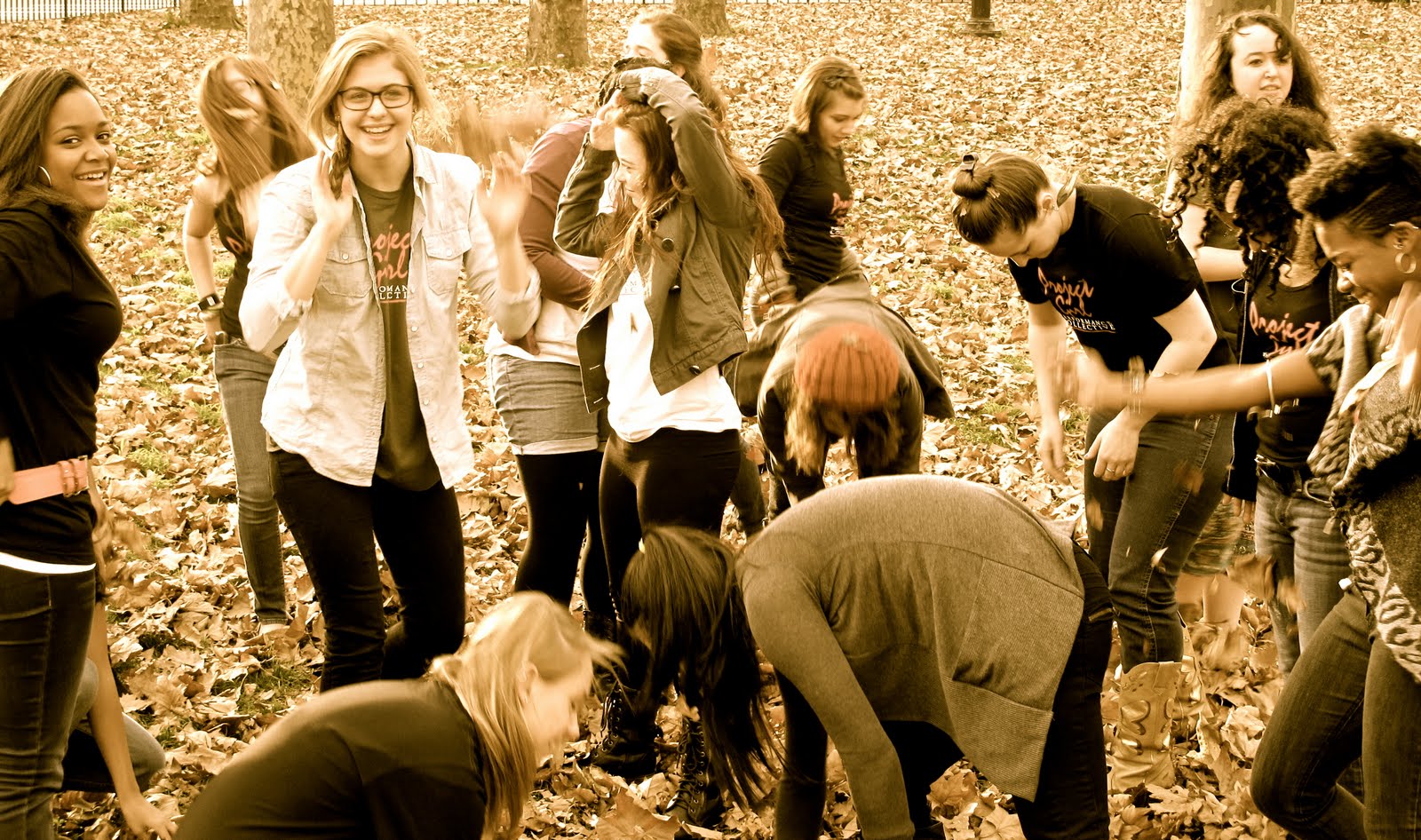
OCTOBER: Yet another Project Girl shot. This was a good day. DUMBO is a great place to shoot. We got a ton of interesting photos. The rain had us sort of bummed out but it didn't stop us from having a good time.
SEPTEMBER: Robert A. K. Gonyo - my fearless COTE partner in crime. Here he is directing the NY Premiere of "Muzungu" by David Myers.
FEBRUARY: Co-Op Theatre East's production of Trojan Women Redux at Looking Glass Theatre, adapted and directed by Casey Cleverly. This features another brilliant talent, Lillian Rodriguez. Should I mention she is also Project Girl alum?
FEBRUARY: Anna and Hannah (as Hecuba and Cassandra). I seem to think I have another photo of them in a similar hold from another COTE show a year back...
FEBRUARY: Anna and Hannah in Trojan Women Redux. One of my favorite elements of this show was the use of the video projections on the broken brick wall screen (you can see it in the back). A regular feature of theatrewashington.org, Why Theatre Matters owes its inspiration toHoward Shalwitz, the Artistic Director at Woolly Mammoth Theatre Company, and remarks Manny Strauss, Managing Editor As someone who came from a family of doctors, started out pre-med in college, detoured to philosophy, then teaching, and finally to theatre — not only did my career choices slide steadily downhill from my mother's perspective, but I was left with a moral conundrum: does my chosen profession, theatre, make a valuable contribution to the world when compared with the other professions I left behind? I guess this conundrum has stuck with me, because as recently as this past winter I made a list of seven reasons why theatre matters and I'd like to share them with you briefly tonight. First, theatre does no harm. Theatre is one of those human activities that doesn't really hurt anyone or anything (except for its carbon footprint -- but let's ignore that for now). While we're engaged in making or attending theatre, or any of the arts for that matter, we are not engaged in war, persecution, crime, wife-beating, drinking, pornography, or any of the social or personal vices we could be engaged in instead. For this reason alone, the more time and energy we as a society devote to theatre and the arts, the better off we will be. Second, theatre is a sophisticated expression of a basic human need -- one might call it an instinct -- to mimic, to project stories onto ourselves and others, and to create meaning through narrative and metaphor.. We see this instinct expressed in children when they act out real or imagined characters and events. We have evidence of theatre-like rituals in some of the oldest human societies, long before the foundations of Western theatre in Ancient Greece. So theatre matters, in essence, because we can't help it. It's part of what makes us human. Third, theatre brings people together. For a performance to happen, anywhere from a hundred to a thousand or more people need to gather in one place for a couple of hours, and share together in witnessing and contemplating an event that may be beautiful, funny, moving, thought-provoking, or hopefully at least diverting. And in an age when most of our communication happens in front of a screen, I think that this gathering function of theatre is, in and of itself, something that matters. Fourth, theatre models for us a kind of public discourse that lies at the heart of democratic life, and builds our skills for listening to different sides of a conversation or argument, and empathizing with the struggles of our fellow human beings whatever their views may be. When we watch a play, we learn what happens when conflicts don't get resolved, and what happens when they do. We develop our faculty for imagining the outcomes of various choices we might make in our personal lives and our political lives. It's not surprising that, in repressive societies, theatre has often been aligned with the movement toward openness and freedom. In South Africa theatre played a role in the struggle against apartheid; in Czechoslovakia, a playwright became the leader of a new democracy. If our own representatives and senators in Washington went to the theatre more often, I suspect we'd all be better off. Fifth, both the making of theatre and attending of theatre contribute to education and literacy. Watching the characters talk back and forth in the theatre is tricky; it requires sharp attention, quick mental shifts, and nimble language skills. It teaches us about human motivation and psychology. In historical plays we get lessons in leadership and government. In contemporary plays, we learn about people and cultures in different parts or our own country or in other countries. Studies have shown that students who participate in theatre do better in school. Making plays together also draws kids out of their shells and helps them learn to socialize in a productive and healthy way. Sixth, theatre as an industry contributes to our economy and plays a special role in the revitalization of neglected neighborhoods. We've seen this quite clearly in our own city. You can look at the role that the Studio Theatre played along the 14th Street corridor, or Shakespeare Theatre along Seventh Street, or Woolly in both these neighborhoods, or Gala Hispanic Theatre in Columbia Heights, the Atlas along H Street, or the new Arena Stage along the waterfront. As each of these theatres opened, new audiences started flooding in, new restaurants opened, jobs were created, the city improved the sidewalks, and neighborhoods that were once grim and forbidding became vibrant hubs of activity. And this pattern has been repeated in cities across the United States and around the world. Finally, the seventh way that theatre matters -- and this one applies to some kinds of theatre more than others -- is that it influences the way we think and feel about our own lives and encourages us to take a hard look at ourselves, our values, and our behavior. The most vivid example of this I've ever experienced was during a post-show discussion at Woolly Mammoth when a woman said that one of our plays made her and her husband decide that they had a serious problem in their marriage and needed to go for counseling; and she was pleased to report that they were still together and much happier as a result. Now, I'll admit, I don't hear things like this every day. But speaking more generally isn't this one of the things we go to the theatre for, to measure our own lives against the lives we see depicted on the stage, to imagine what it would be like if we had those lives instead? And isn't it a very short step from there to saying, gee, maybe there's something I should change about my own life? And it may have nothing to do with the message that the playwright wanted to deliver! Maybe the play is about a fierce battle over a family dinner that breaks the family apart over irreconcilable political divisions -- but maybe you watch the play and say, gosh, wouldn't it be nice to at least have a family dinner once in a while, and so you decide to plan one for next month. So, those are my seven ways that theatre matters: it does no harm, expresses a basic human instinct, brings people together, models democratic discourse, contributes to education and literary, sparks economic revitalization, and influences how we think and feel about our own lives.7 Reasons Why Theatre Makes Our Lives Better
11 COMMENTS
(a portion of which appear below) that he so eloquently delivered on September 17, 2011 at Woolly’s Dinner on Stage event. These words so perfectly capture the core of why we at theatreWashington are inspired by Washington area theatres, artists, and audiences of all ages. In future pieces, we will share many other perspectives on this important topic. We also would love to hear why theatre matters to you!
mstrauss@theatrewashington.org